Volcano
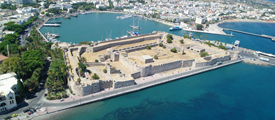 Kos is an island of majestic beauty, lying in the centre of the Dodecanese chain in the Aegean Sea. ("Dodecanese" in Greek means "twelve islands"). Lying north west of Rhodes and south east...
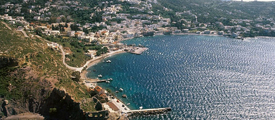 Leros Island is approximately 53 square kilometres. The island consists of one municipality which has its administrative headquarters in Platanos. The most important villages of Leros...
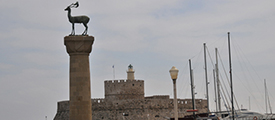 Rhodes is the biggest island of the Dodecanese. It lies at the south-eastern corner of the Aegean, opposite the coast of Asia Minor, about 11 miles away. It has an area of 1398 square...



Western Archaeological Site
- Category: Kos Town
- Published on Wednesday, 13 June 2012 13:29
- Written by HostPlus ltd
- Hits: 4674
-

-

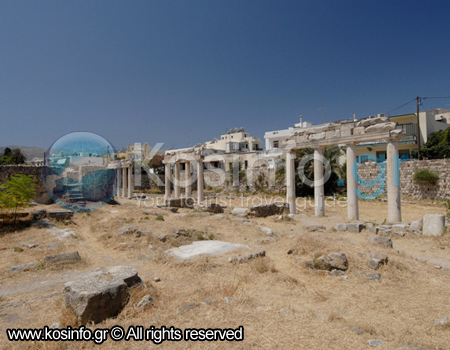 It’s located in the centre of the city south of the stadium, north of the conservatory. North west of the Roman settlements and south west of Acropoleos Hill. Inside the site they have found parts of a Gymnasium, The Western Baths, the sanctuary of the Nymphs, the house of Europe, Slinou’s house,
the mosaic of Parido’s judgement, two old Christian basilicans and a cross road.
Western Gymnasium It was in close proximity to the stadium from which it was separated by a narrow road 1,20 metres wide. It was located B-D 200 metres and A-D 120 metres. It had an interior yard which went right by the gymnasium. Part of the arcade was found in the west. House of the Kidnapping of Europe The name was given because of the mosaic floor which depicts “The kidnapping of Kos Island - House of the Kidnapping of EuropeEurope” by Zeus transformed into a Bull. The home has been restored and still be visited today in the western Archaeological area. Its initial construction dates back to the ancient Greek times at the end of the 3rd century and the beginning of the 2nd century BC. The type of monument we see today goes back to the Empire period. We can distinguish two different styles, one older, one from the 2nd century BC and a more modern one from 225-250 century AD.
Basilica A It is situated in the archaeological area of West Thermae. It was built after the 469 earthquake, where the Roman baths (frigidarium) used to be. It had three navs with a large semicircle arch in the east which had a semi-circle amphithetre seating where the clergy would sit. The Communion table was supported by five cone shaped columns whose bases can still be seen today. It was probably destroyed by the earthquake in 554.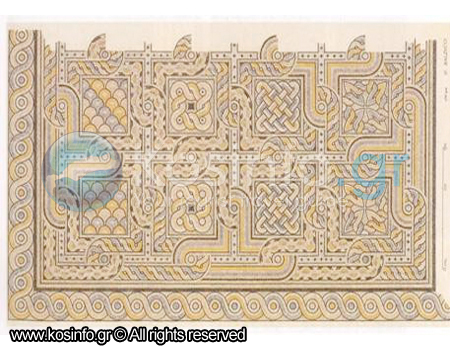 Basilica Β It is situated in the archaeological area of the West Thermae.Kos - Basilica A, B It was built after the earthquake of 469 and occupied the area of the warm baths (caldarium) where the Roman baths used to be situated. From the temple a few architectural elements were kept but many marble architectural parts, among which is the impressive pulpit which is kept in the Castle of the Knights. Many of these have been constructed from a special kind of marble. South of the temple, the Baptistry is attached to a square lit up area and a cylinder font.The marble monumental entrance was reconstructed during the Italian reign. The Basilica and the Baptistry were probably destroyed by the earthquake in 554.