Volcano
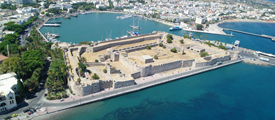 Kos is an island of majestic beauty, lying in the centre of the Dodecanese chain in the Aegean Sea. ("Dodecanese" in Greek means "twelve islands"). Lying north west of Rhodes and south east...
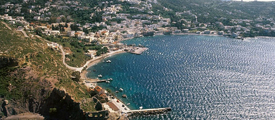 Leros Island is approximately 53 square kilometres. The island consists of one municipality which has its administrative headquarters in Platanos. The most important villages of Leros...
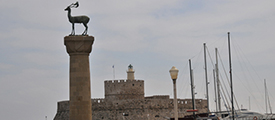 Rhodes is the biggest island of the Dodecanese. It lies at the south-eastern corner of the Aegean, opposite the coast of Asia Minor, about 11 miles away. It has an area of 1398 square...



Middle Ages Hora
- Category: Kos Town
- Published on Wednesday, 13 June 2012 18:31
- Written by HostPlus ltd
- Hits: 7066
-

-

 Pre earthquake Kos had the form of a typical city of the 18th and 19th century in the southeastern Aegean divided into districts. According to sourced of the time in the walled medieval city Hora., Jews and Greek orthodox mainly resided there. It was not unusual for wealthy Turkish or Greek families who lived in Hora to also have a country home outside the walls, in the area of the Orange groves or they may have had a shop along the harbour. The exterior city has been transformed into districts which correspond to Christians, Jews and Muslims. The division of the residents of the island into districts, remained almost unchanged till the end of the 19th century till 1928, the period in which the first reconstructions of the big public buildings by the Italian conquerors. The destructive earthquake of 1933 flattened the city and gave the chance to the Italian administration for the reorganization of the city of Kos into a modern planned city incorporated the ancient sites which had been excavated. The plans which were used gave Kos the look of a metropolitan city of the East. Parts of this reconstruction is still visible today.
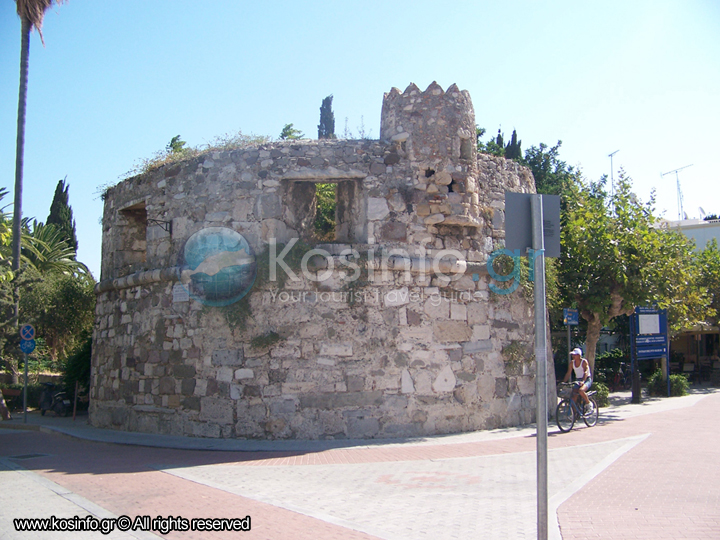
 Kos Island - Fortification Medieval CityFortification of the Medieval City The fortification of Hora may have began in the last decades of the 14th century by the Great Magistro of Heredia Battalion and commander of Kos Schlegelholz so as to protect the medieval city from the attacks by the Sultan Bagiazit A’. It was completed in 1500 with the opening of the new commander’s Constanzo Operti moat which had a 16 metre width and length on the south side (todays Ippocrates street). On the exterior of the northern side there was a lake which is described in the official papers of the knight’s and other visitors. The wall consists of one of the simplest and oldest examples of defensive architecture by the Knights of the Dodecanese. Parts have been saved but the area which it surrounded is in the archaeological site of Ancient Agora.
The fortification was almost rectangular and was reinforced with bastions on the south south-west and north-east corner. The Northeastern side was not saved. Kos Island - Middle Ages HoraThis was where the command centre was until the 1926 earthquake. Today a large part of the southern side has been preserved where two small rectangular towers were saved. From the northern side only a small part was saved. It was part of the embankment of Platanos of Hippocrates, opposite the entrance of the Castle of Neratzia – today’s Finikon Street. On the western is the Forou Gate while the eastern side was destroyed. It had five gates, The Gate of the Sea in the eastern part, which wasn’t saved as were two other gates which opened towards the northern side: one towards the Castle of Neratzia and one towards the Sea. Both have been preserved. a)Gate of Forou: Monumental entrance on the eastern side of the perimeter wall of Hora, it had an ancient dressed stone masonary as a lintel and above this a semi-circle arch. b)The South East Gate: It’s situated in the eastern end of the southern fortification towards the sea. It’s on the embankment of the entrance, centrally situated and possibly used a second gate, it was found built into stone witht the emblem of the Great Magistrou De Heredia (1376 – 1396) of the Battalion under the command of Kos Schlegelhotz (1386 – 1412). Kos Island - Middle Ages HoraOn the top floor there were additions were made by the Turks. These consisted of a series of oblong openings and small arches.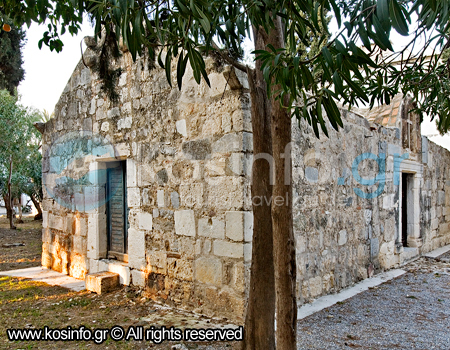 Knightly Home - Home of Commander Francesco Sans (1514) It’s situated along Miaouli coast and was inside the perimeter wall of the Medieval city. It’s the only secular building of the Knight era in kos which was built in 1514 by the Commander of Kos Francesco Sans. It consists of two covered rectangular areas. Initially the main entrance was the western one (in Mesologgiou street). During the Turkish reign the building was used as a coffee shop and two windows were opened on the eastern side (in Akti Miaouli street) symmetrically with the western windows. The transformation of the eastern side was done during the Italian reign. It was reconstructed by the 4th department of the Byzantine and was used as an archaeological library and exhibition area. The walls were quite well taken care of with carved stones, sculpted cornices and archaeological materials. Kos Island - Middle Ages HoraOn the top and on the right from the southern entrance and the western side was a built in emblem of the Great Magistro Fabrizio Del Carretto and the emblem of the Commander Francesco Sans and the year was 1514.
St. John Prodromos or Naukliros It belongs to the type of temple which had a one room area covered with a three sided exterior arch and two entrances, one on the west side and one on the south side. The temple was dedicated to St John, protector of the Ioannites Knights and dates back to the 15th century. In 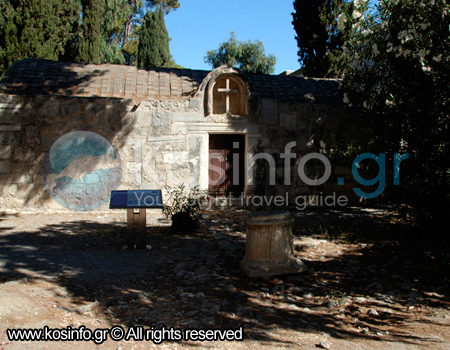 the beginning of the 19th century, before the construction of St Nicholas church, it held the place of the Metropolis Temple for Hora.
In the middle of the 19th century the public of Kos chose Anastasio Platanista as head preservation and repair because the temple had suffered much damage even before the earthquake of 1933 and it was almost in ruins before the earthquake occurred in 1861. It seems the repairs which Platanista took over were never completed. Straight after the earthquake, excavation of Hora began. Kos Island - Temple St Marys KatevatisThe rubble from approximately 400 houses was taken away and three of the nine churches of Hora were demolished. During the excavations of Hore carried out by the Italian Archaeological Mission, it was ascertained that it had been built over the sanctuary of Afrodite. In June 1943 it was decided to move the sanctuary to the north west part of Hora. This was considered a very important technical job for those days. During the reconstruction to complete the side walls and the construction of the chamber, soft stone from Kefalos was used. The completion was done in an alcove and a discreet ridge divided the tow sections. They made the chamber watertight using plumbing plaster. In 1947 the bishop of Kos, Emmanuel Karpathion, dedicated the church to a new latter day martyr St John Of Naukliro. After applying to the Mayor the bishop renamed the street leading to the church Nauklirou Street.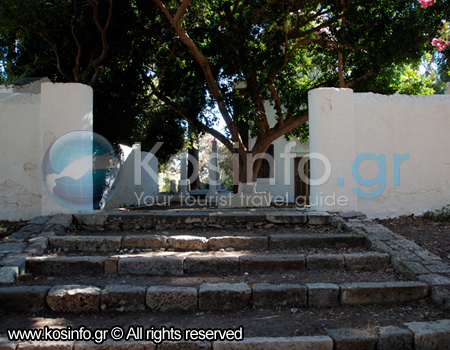 Temple of Mary Gorgopigi The first mention of this church is made in the A’ code of the Metropolis in 1693, where it is mentioned that ownership of the vineyards was shared by Mary Neohoritissa. Kos Island - Middle Ages HoraThe Bishop of Kos Emmanuel Karpathiou, mentions the name Goropigi: the title was changed to the more popular Gorgopigin. Today we use the name which means quick spring and shows that St Mary Gorgopigin will quickly do the bidding of the person who is asking for help. The church is a one chamber temple with a three sided arch on the exterior and two entrances, one in the middle of the south side and one in the middle of the west side. The chamber near the roof is slightly raised and is covered by carved stones with smaller stones used as well. The walls were made from old marble pieces and signs. The floor was made from red square clay blocks. In the centre of the main temple there is a marble tomb stone.
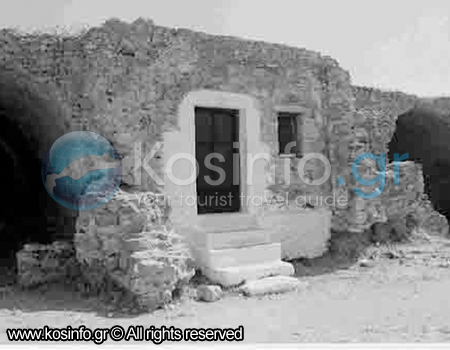 The main temple is divided by the Holy Podium with a wood carved temple of exquisite craftsmanship which dates to the 18th century. Inside, the walls of the temple have scenes depicted on them, mainly on the south wall of the main temple and the Arch of the Sanctuary. Two layers were found , one which dates to the 15th century and the other to the 16th century. kos-St-nicholas-churchIt is believed that the walls can be attributed to the artist Nikoloaou who also painted the temple of the Hora Castle in Kalymnos and the temple of St Mary Kastrianon in Old Pyli. The illustrated part of the temple shows that the temple was built inside the walled area of the city at the beginning of the 15th century.
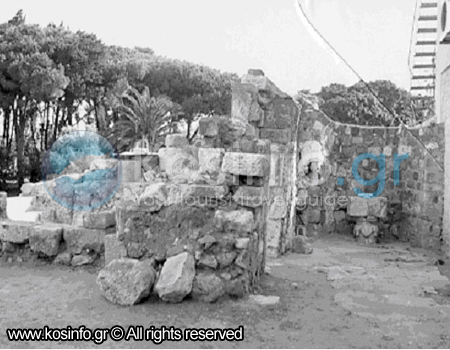 St. George According to the Metropolis records, the building was finished in 1882. It was located in the south eastern part of the archaeological area of the Agora. In the yard there was a temple of St George and the tombs of Dimostheni and Alexi Thimanaki. In 1772 during the reign of the Bishop Kallinikou, the temple was inside a vineyard and was surrounded by a wall. Owner of the temple was the church St Marina.From the beginning to the end of the 19th century the temple donated a lot of money to the Metropolis temple and it shows a lot of income. In 1892 it is built in the memory of Ekaterine daughter of Panteloglou wife of Alexiou Thimanaki.
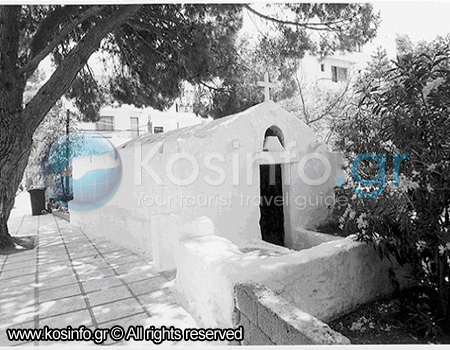 The First School in Kos The Kos Bishop Emmaouel Karpathiou, after many years of research, concluded that at the end of 17th century beginning of the 18th century, very few people in Kos knew how to read and write. Those that did know were mainly priests who only knew the basics so as to be able to sign and perform duties. The chanters weremonks from large monastries which had chares in Kos ( St Catherine of Sina, St Mary of Kikkou in Cyprus, St John Theologou in Patmos) and they had helped in teaching the basics. In 1773 the first public decision, after the initiative was taken by Archbishop Kallinikou, to open the first school. Kos - The Temple of Saint Constantine & EllenAt the meeting which was held on the 20th October 1773 two committee members were elected, Mr Aslanis and Mr Stamatakis (codeA’ 206 – 207). At the meeting the first teacher was present. The monk Daniel who was given the position of teacher by the Archbishop Kallinilou. He was also responsible for paying the rent.
 Temple of St. Marys Katevatis It’s situated in the archaeological area of the Agora. It takes up the southern part and consists of six domed storerooms which are situated near the southern side of the area. It’s a single covered chamber area, and has a semi circle arch in the eastern area and an entrance in the middle of the western area. In the middle of the chamber on the roof there was a circular opening and according to tradition it was used for the easy access of the churchgoers. The temple was dedicated to St Mary of Kikkou and had shares in the Monastry of Kikkou in Cyprus. It was located in the surrounding area of the pre-earthquake Metropolis temple of St Nicholas.
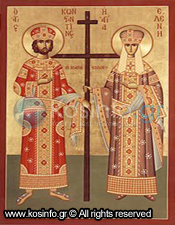
Temple of St. Constantine and Eleni It was a single chamber covered by a roof with a semi circular arch in the eastern side and had an entrance on the west and south side. It was possibly built on the site of an older temple because foundations of a three sided arch on the eastern side were found.
 Located Opposite the Entrance of the Castle of Neratzia and the Lotzias mosque. The fountain of the mosque has an Arabic sign which refers to “the water of Hippocrates.” It’s an age-long plane tree at least 500 years old and according to tradition, Hippocrates taught his students under the shade of its leaves.
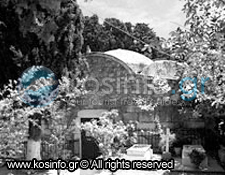 Today it is used as cemetery temple. It is the central building, the old Christian basilica. Balducci dates it to the 7th – 8th century because of its construction. Parts of the Basilica were excavated during the Italian reign, but today we have no traces of them. It is possible that there were two Basilicas on either side since research
 The castle of Neratzia was built by the Ioannites Knights on a small island on the south side of the harbour of Kos. It communicated with a mobile bridge with the surrounding city called “Hora”. As is already well – known, after the Knights of the Order of St John of Jerusalem,
 to the Sultan till 1912. The Castle of Neratzia presents two chronological phases which belong to the Hippocrates period and the period of repairs and substitute works during the Turkish reign. Kos Island - Castle NeratziaDuring the older phase there was an interior surrounding wall which can be dated by the emblems of the Great Magistros to the 3rd quarter of the 15th century. It is divided from the exterior from the south, the west and the northern side by an interior moat.The entrance towards the wall opens into a square tower of the south western side of the castle and is constructed using marble doorposts and marble lintels which bore the emblem of the Great Magistro d’ Aubusson of the Kos Battalion Carndino during 1478. The corridor of the gate is covered by ten (10) stone columns made of granite which come from the old Christian basilica of Limenos.
 During the Italian reign it was transformed into a flat avenue, todays Finikon Street. The bastion of the exterior wall had domed corridors which led to the side areas which had cannon holes. To be able to deal with the smoke from the cannons, air shafts were constructed. The roof of the prebattle area was transformed into powerful cannon holes. The polygon bastion of D’Aubusson (1476-1503) may have been the first to be constructed. Work began in 1489 with the intent of protecting the northern side of the castle. Kos Island - Castle of NeratziaIn the south west corner was the port of Kos and the bastion of the Great Magistro Fabrizio del Carreto (1513-1521). It was of circular shape with singular openings of the cannon areas. In the eastern side of the exterior wall there is a square bastion of D’Aubusson(1476-1503) with a square perimetrical corridor on the ground floor with nine cannon holes and air shafts for ventilation and a stone scale which leads to the first level and the roof. The works which followed the bastion were built with stones and for the biggest part were carved.
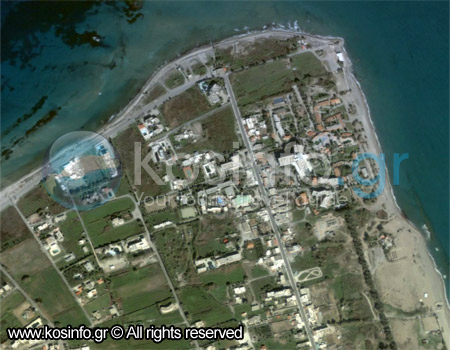 It has three naves with semi-circle arches on the east side and a rectangular antenave on the west. Most parts of the upper construction as well as many marble architectural parts were used for the construction of the surrounding windmills that lie in the area. Here the baptistery chamber with its cross shaped font and