-
Category: Kos Town
-
Published on Wednesday, 13 June 2012 13:44
-
Written by HostPlus ltd
-
Hits: 5505
-

-

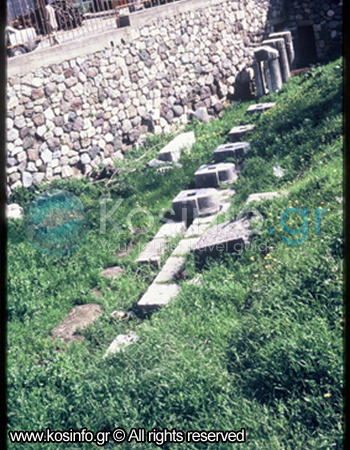
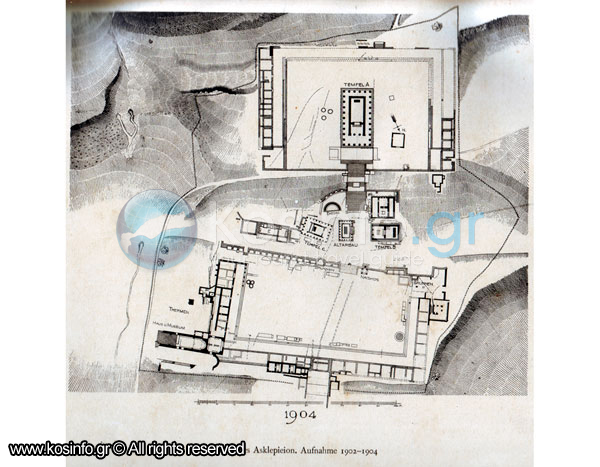 The Asclipio of Kos seems to have been established in the 4th century BC on the sides of a low hill with a view towards the sea of Asia Minor. It was located close to the ancient city of Kos in an open area with running water, close to the springs of Bourinnas and Red Waters.
It was surrounded by the well known woods of Pine trees. It had always been one of the ,most famous monuments in Kos, rich in offerings of great works of art by famous artists. The Asclipio of Kos is connected to the works of one of the most important representatives of medical science, Hippocrates (460-380 BC). Hippocrates established the Medical School of Kos as well as the other Asclipia. Initially he followed the traditional therapy of the times. A priest would come and examine the patient in detail and then they would cleanse the patient and then offer sacrifices.
 According to the traditional religious therapy, God would appear in the patients dreams and cure their worries and their illnesses. As compulsory payment the patient had to sacrifice a rooster. The Asclipio of KosThe practice was followed during the Greek period while later it seems there were more professional doctors, who cured the patients using more scientific methods. Research to find the Asclipio began at the end of the 19th century and was discovered at the beginning of the 20th century by the German archaeologist Rudolf Herzog aided by the Kos historian Jacob Zarrafti. Zarrafti noticed that one of the small Byzantine temples was dedicated to the Tarsou virgin Mary. He assumed that the name Tarsou was a word used for “woods” and was referring to the “woods of pine trees” which was adored by Kiparisios Apollon. In combination with the ancient springs it showed the position to Herzog and in 1901 excavations began, which then continued till 1905. TThe Asclipio of Koshe excavation continued in the 1930’s under the
 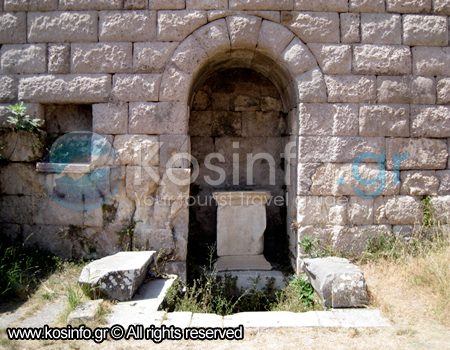 Italian Archaeological Mission which led to further reconstructions which still stand today. In the area which later became a sanctuary, there was initially an area of worship for the curing expert Peionas and Apollo, Asclipio’s father. In this area there was dense woods with pine trees – dedicated to the worship of Apollo Kiparission which was protected by holy law. Other gods were worshipped at the Asclipio like Zeus, Ikesios, Athena Fatria and Apollo Karnios, while in the 4ht century BC the worship of Asclipio was also included and an altar was constructed in his honour.
The worship of Asclipios proved to be one of the most important public worships of Kos during the 3rd and 2nd century BC, especially after 242 BC the year when Kos ensured the acknowledgement of immunity, that is the protection of the sanctuary from attacks of any kind. They also established the Geat Asclipia, a celebration where musical and nudity competitions were held in which all Greek cities took place. The Asclipio of KosDuring this period the sanctuary was developed as a unified group of buildings with the aim of promoting the worship of Asclipio and to gradually expand in to three smaller buildings, the lowest of these (93x47 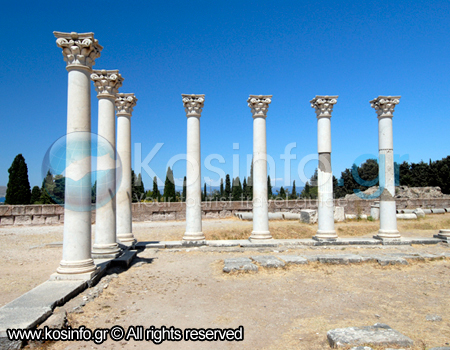 metres) was surrounded by arcades. The centre of worship initially consisted of the altar of Asclipios, his son Mohoana and Igeia. South of the temple a square building was added, the Avaton which may have functioned as a cemetery for the patients. In the eastern part of the altar an arcade was constructed(length 17,3 and depth 6.48) where votices were placed towards the North in a semi-circle for outdoor gatherings.
At the beginning of the 2nd century BC the Asclipio was placed under the protection of King Eumeni the second of Pergamou and gained the appearance it has today. It developed into three successive smaller buildings which contained an entrance, arcades, temples, altars, sacred woods, and other smaller different items of worship and buildings, while monument scales helped to reach the different levels. The Asclipio of KosThe entrance to the group of buildings was through a monumental four column area which had an 11,5 metres width. The woden arcades of the lower building was replaced by Doric style arcades. The areas were  transformed into places for pilgrims of the sacred area. In the 1st century AD they built the first level which contained toilets, known as vespasians, springs and a library. At the same time a small chapel belonging to the Kos doctor Gaiou Stertinou Xenofontos, who lived in Rome and was the personal physician of the Emperor Tiberius, Klaudios and Nero. The springs, the water supply and the library were his donations.
In the 3rd century AD a large group of springs were added to the eastern side of the lowest buildings. In the second building an 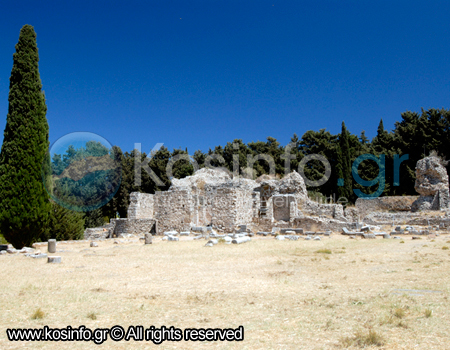 area was transformed and decoarated with statues and fountains necessary for the ceremonial therapies. The Asclipio of KosIn the second building, the altar of Asclipio was modified adopting the characteristics of Asia Minor and was reconstructed using the prototype of the altar of Pergamou. In the 2nd century AD during the Antonian Age another temple using Korinthian design was added and was dedicated to Apollo. Finally a bigger and more impressive central area was reconstructed. It led to the last building where a large Doric temple was built and dedicated to Asclipio, which was a copy of the temple of Epidaurus.
 A monumental area which led to the higher building was surrounded by arcades of Doric design in a Π shape with a Doric temple in the centre. The Asclipio of KosDuring the Byzantine period, possibly the 11th century, a church was built Panagia Tarsou which was part of the Patmos monastery. The area continued to function for some time as is shown by the coins found during the 4th century AD. It was abandoned after the earthquakes which occurred in 469 to 554 AD. In the 15th century the Asclipio was attacked by the Knights of Command of Saint John of Jerusalem. They used the building material to construct a Medieval Castle.


 Volcano
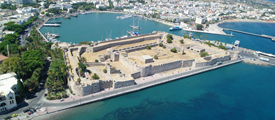 Kos is an island of majestic beauty, lying in the centre of the Dodecanese chain in the Aegean Sea. ("Dodecanese" in Greek means "twelve islands"). Lying north west of Rhodes and south east...
 Leros Island is approximately 53 square kilometres. The island consists of one municipality which has its administrative headquarters in Platanos. The most important villages of Leros...
 Rhodes is the biggest island of the Dodecanese. It lies at the south-eastern corner of the Aegean, opposite the coast of Asia Minor, about 11 miles away. It has an area of 1398 square...



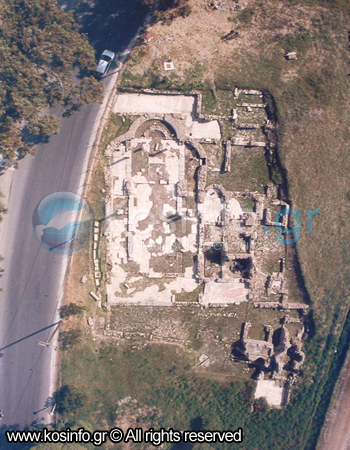 It’s located in the area of Psalidi at a short distance from the city and next to the coastal road. It’s a big Basilica, rectangular and spreads to the west. The south side has many smaller buildings. Among these is the Baptism area with a cross shaped font. In the foyer the floor had a mosaic design while the rest of the floors were covered with large marble stones, smaller clay ones and coloured hexagon and square shaped ones.
 The stadium is rectangular and is 1,80 metres long and 30 metres wide.Its northern side was equipped with an automatic starting system known as isplix. During the Greek period benches had been built only in the eastern side. During the Roman period benches were added to the western side too.
 It’s located in the most southern part of the ancient city and a part of the orchestra and stage have been excavated. The width is estimated at 108 metres and it could hold 13,000 – 14,000 people.
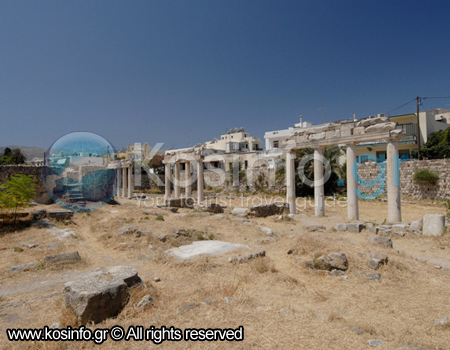 It’s located in the centre of the city south of the stadium, north of the conservatory. North west of the Roman settlements and south west of Acropoleos Hill. Inside the site they have found parts of a Gymnasium, The Western Baths, the sanctuary of the Nymphs, the house of Europe, Slinou’s house,
 House of the Kidnapping of Europe The name was given because of the mosaic floor which depicts “The kidnapping of Kos Island - House of the Kidnapping of EuropeEurope” by Zeus transformed into a Bull. The home has been restored and still be visited today in the western Archaeological area. Its initial construction dates back to the ancient Greek times at the end of the 3rd century and the beginning of the 2nd century BC. The type of monument we see today goes back to the Empire period. We can distinguish two different styles, one older, one from the 2nd century BC and a more modern one from 225-250 century AD.
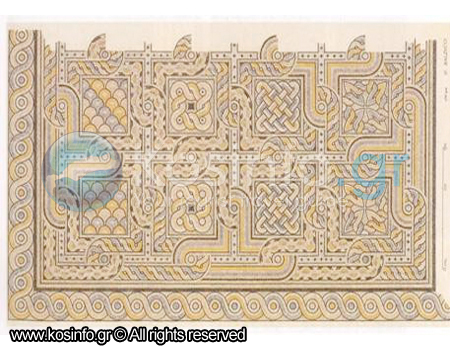 Basilica Β It is situated in the archaeological area of the West Thermae.Kos - Basilica A, B It was built after the earthquake of 469 and occupied the area of the warm baths (caldarium) where the Roman baths used to be situated. From the temple a few architectural elements were kept but many marble architectural parts, among which is the impressive pulpit which is kept in the Castle of the Knights. Many of these have been constructed from a special kind of marble. South of the temple, the Baptistry is attached to a square lit up area and a cylinder font.The marble monumental entrance was reconstructed during the Italian reign. The Basilica and the Baptistry were probably destroyed by the earthquake in 554.