Volcano
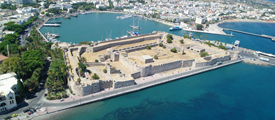 Kos is an island of majestic beauty, lying in the centre of the Dodecanese chain in the Aegean Sea. ("Dodecanese" in Greek means "twelve islands"). Lying north west of Rhodes and south east...
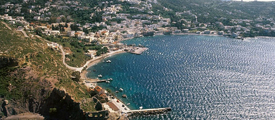 Leros Island is approximately 53 square kilometres. The island consists of one municipality which has its administrative headquarters in Platanos. The most important villages of Leros...
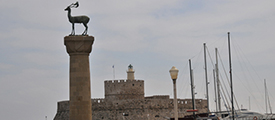 Rhodes is the biggest island of the Dodecanese. It lies at the south-eastern corner of the Aegean, opposite the coast of Asia Minor, about 11 miles away. It has an area of 1398 square...



Kos Town Monuments
- Category: Sightseeing
- Published on Saturday, 16 June 2012 18:06
- Written by HostPlus ltd
- Hits: 6749
-

-

 Other than the imposing Castle and the charm of the old town, a visitor arriving in Kos for the first time will certainly be impressed by the archaeological sites scattered inside the town. According to sources, the homonymous ancient capital of the island was one of the most beautiful coastal towns in the ancient world. The buildings that adorned Kos during the Hellenistic years were the theatre, the prytaneum, the gymnasium and the ancient agora - buildings that served the dual purpose of functionality and decoration.
Its perimeter was 4 kilometres with a separate fortification for the harbour. Some sections of the ancient wall dating back to the 4th century B.C. were discovered in excavations carried out at the harbour. The catastrophic earthquake in 1933 gave the opportunity to German and Italian archaeologists to carry out more intensive excavations in the town of Kos, and since there were many monuments, the excavations were divided into zones.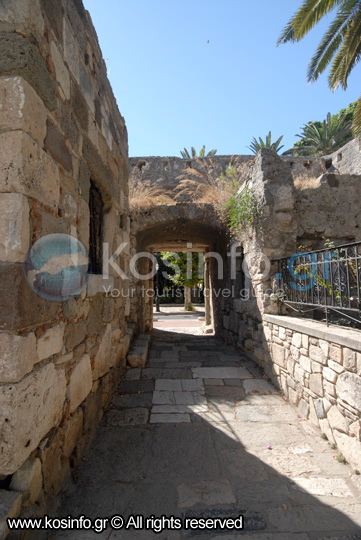 EASTERN ZONE: The complete area around the harbour of the Medieval town was examined and the monuments that came to light became known as the harbour excavations or the ancient Agora excavations, and are all included in the eastern zone. A large section of the wall (80m by 2.5m high) built with large stones is discernible. The eastern arm that protected the harbour began from the external side of the wall. All the buildings necessary for the harbour to operate as well as the churches -which faced the Kos Monuments Ancient Agoraharbour- were sited outside the wall. The eastern arm acted as a brace for an impressive colonnade 50 metres in length, dating back to the 4th or 3rd century B.C., with a row of rooms. During the Roman era the greater part of the colonnade was restored and it was later covered by an early Christian Basilica by Limenos. In modern times the baptistery of the Basilica was called the "Seven Steps of Aghios Ioannis" (Saint john). A small temple (possibly dedicated to Hercules) and mosaic floors in the rooms next to the sanctuary dating back to the 3rd century B.C. were also discovered. Other findings from the temples and sanctuaries belong to the Aphrodision or the Sanctuary of Pandimou and Pontias Aphrodite. The Agora, built right next to the harbour in order to facilitate trade, was in accordance with very recent findings, a building 80m wide with a length of about 300m. An impressive stairway leads from the road to the internal yard. Two columns that have been restored form a type of portico. It is estimated that the first construction of the Agora was between the 4th and 3rd centuries B.C., while the few pieces from the buildings that have been preserved clearly show many construction periods.
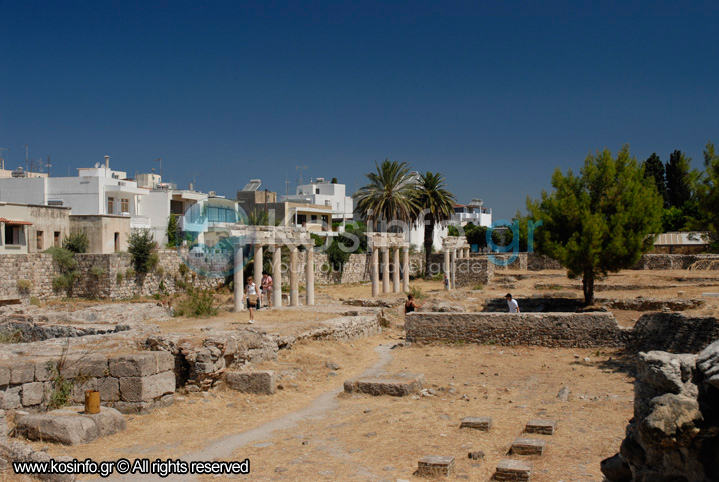 WESTERN ZONE: The Thermes (Baths) in the harbour is comprised of a circular hall with porticoes and is situated on the corner of Omiros and Irodotou Streets. The northern Thermes were found along 31st March Street, dating back to between the 4th and 3rd centuries B.C. Here the archaeologist's pickaxe discovered a remarkable inscription detailing the worshipping regulations of "Enagoniou Hermes" The ruins of the ancient Stadium were discovered south-west of the northern Thermes. In 1900 the German archaeologist Herzog discovered the "afesis" of the Stadium; i.e. the specially formed starting point for runners. The western zone of excavations includes the Hellenistic Gymnasium (i.e. athletics gym) known as "Xysto". The Gymnasium was thus named from the habit of the athletes of scraping (xisoun) their bodies in order to clean it from the oil they anointed themselves before the races began. A row of 17 restored columns from the ancient Gymnasium are an impressive sight. There was a water tank in the middle of the Gymnasium where athletes could wash themselves, and the western Thermes were adjacent for the same reason. A paved rKos Monuments Hellenistic Gymnasiumoad (Decumanus Maximus) 10.5 metres wide with broad pavements and arcades bisects the town, crossing a second road, the Cardo. There were many Roman buildings on both sides of the road, while complex sewerage and drainage systems were also discovered beneath both roads. To the east of the Cardo we'll come across a charming restored building - the 3rd century Thermes Nymfeo or Forica. When the building was first discovered, its elegance initially led archaeologists to the conclusion that this was a sanctuary dedicated to the nymphs, but it was finally determined that the building was in fact a luxury public urinal. There are various ancient ruins north of the Decumanus, including the House of the Europa Mosaic. To the left of the yard a 3rd century mosaic floor was discovered in a small hall, depicting a nude Europe being held by the throat and the side of a bull. Many statues have been found here, including those of Asklepieion, Artemis and Hygeia, which we can see and admired in the Archaeological Museum. Opposite the Gymnasium is the Roman Odeon, built in the 2nd century, which has been well preserved. The concave opening has nine marble rows that have been restored, a landing and then another five rows made of granite. The lower stands made of marble were for the more "respectable" citizens while the higher stand made of stone was for the remaining spectators. Other sections that were also saved are the floor of the proscenium and the wings, as well as the orchestra pit.
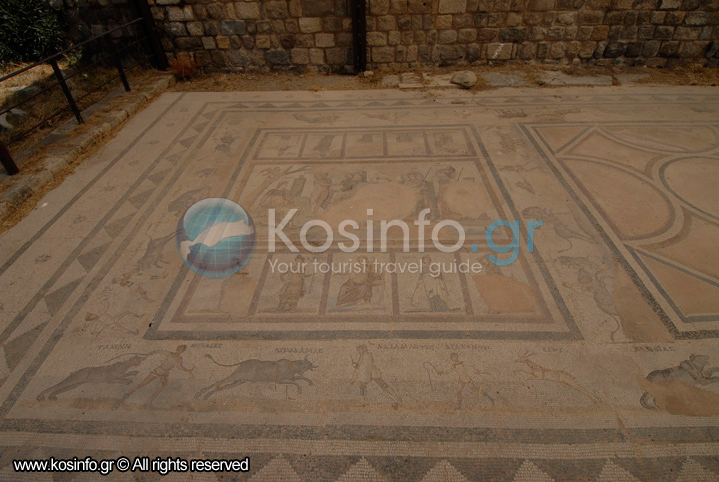 CENTRAL ZONE: The main artifact found in the central excavation zone is the Casa Romana, to the right of Grygoriou 5th Street. This is a 3rd century. Roman villa built over the ruins of a Hellenistic house, where wonderful mosaics were discovered. The villa is Pompeii style with 36 rooms and 3 atriums or internal atria yards with small tanks in the middle, together with a plethora of adornments. In the hallway of the first atrium one can discern a fountain which at one time had a small statue of Asklepieion, while an exquisite mosaic depicting sea animals was found on the floor of an adjacent hall. TKos Monuments Mosaiche latter is now in the Archaeological Museum. In the second atrium the walls are covered with marble and mosaic covers the floor around the water tank, depicting dolphins and a sea-nymph on a sea-horse. The third atrium is the largest, bordered by double and single rows of pillars in an arrangement called "rodiaki stoa". The rooms have mosaic and wall murals. We come across the ruins of the Central Thermes outside Casa Romana, with the ruins of Dionysos' altar lying to the north-east. The temple, which dates back to the 2nd century, was built with white and greyish-blue marbles.
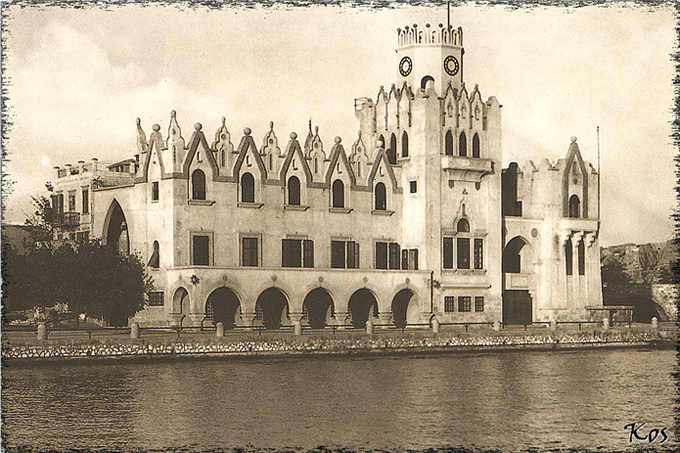 It is located on Akti Miaouli and it was inside the perimetric wall of the Medieval town and in contact with it. It is the only saved secular building of Knightly period at Kos that was built in 1514 from the Governor (Komentori) of Kos Francesco Sans. Composed by tow arch – covered orthogonal areas. Initially main visage was the westerner (on Mesologgiou street). On Turkish domination the building was used as café and they were two ports opened of the east side (on Akti Miaouli) symmetrical with those of the west side.
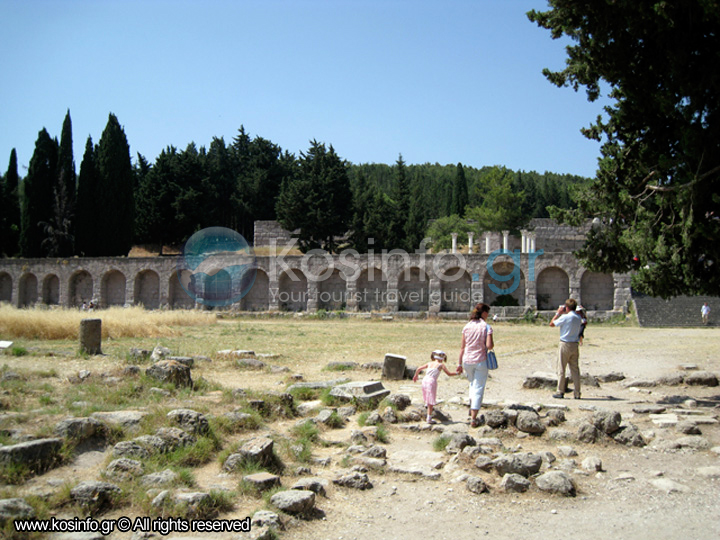 In a distance 3.5 kilom. northwest of Kos town, at the slopes of a low mount with a view at the coasts of Asia Minor, there is the monumental complex of Asclepio. The space was located in the beginnings of 20th century by the German archaeologist R. Herzog and the research continued later Italian archeologists who attempted, and the restoration of the monument projecting mainly to the Roman side. The complex is extended in three mounds. At the lowest a gallery at Π shape (3rd century b. C) that today is maintained in level of foundation,
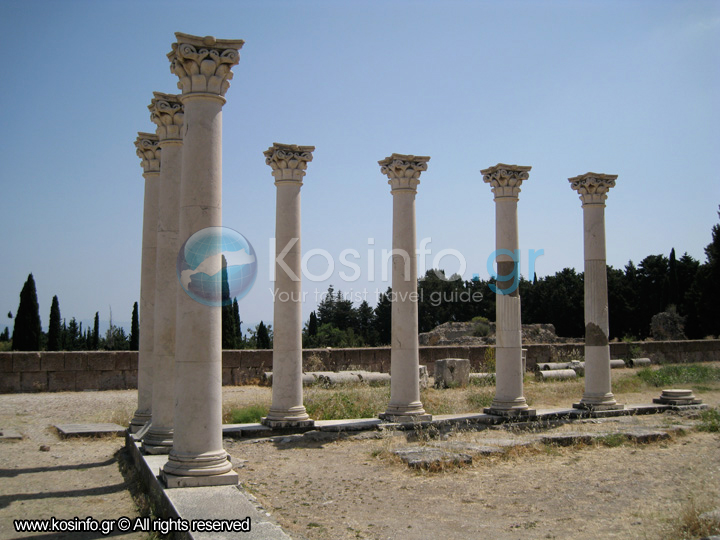 In the middle mound are remains of the altar of Asclepius (4th century b. C) and opposite the mound is saved the Ionic temple of Asclepius. South of the temple it was the untrodden, where the patients Kos Island - Asclepion Archeological war laying waiting for God’s Help. South of the untrodden there is the entrance of the holly source. East of the altar is placed a small Corinthian temple (2nd century. AD) dedicated, probably, in Apollo. At the third and upper mound dominates the big Dorian temple of Asclepius (2nd century b. C), copy of the corresponding in Epidaurus. The temple is surrounded by gallery at Π shape. The temple in the Early Christian years was changed in to a church with the name Panagia Tarsou. A big department of temple was litho logiest by the Knights of the battalion of Saint Ioannis of Jerusalem.
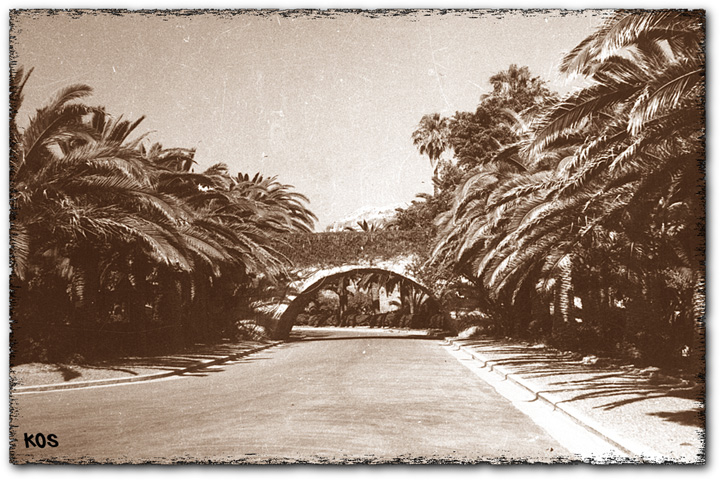
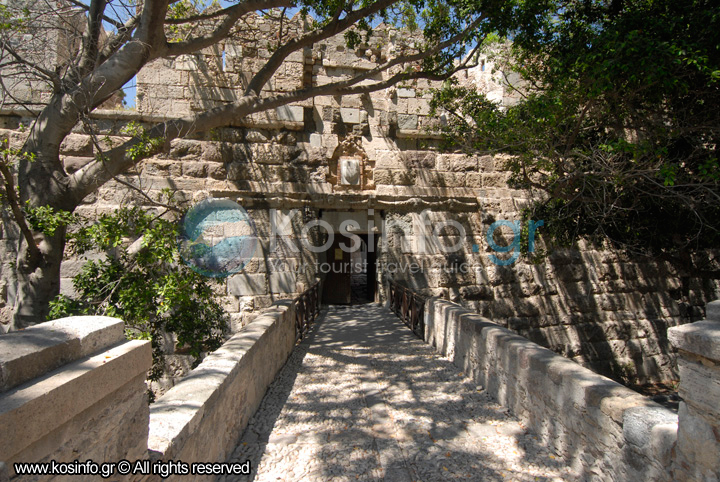 The castle of the Knights of the Order of Saint John is situated at the entrance of Kos harbour on what used to be an island in antiquity, communicating with the inland through a bridge that one can still see even today namely the bridge of “Phoinikon" (Palm Trees) Avenue. The castle consists of two defensive precincts. The interior one has four circular towers in the corners; the south-eastern tower forms part of the exterior precinct, which is the larger one of the two, with massive bastions on the four corners, battlements and gun ports.
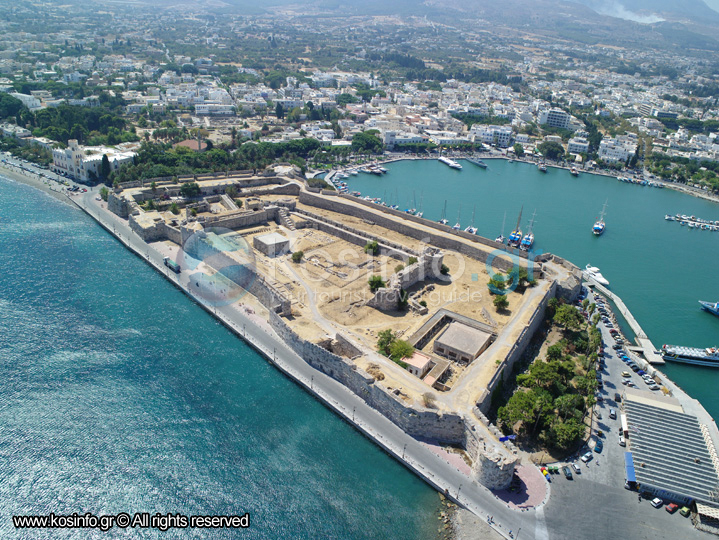 Over the main gate' s one sees an Hellenistic frieze with masks and garlands. On the gates ceiling (the central gate, known as the Carmadino gate) there are basalt columns placed obliquely, which come probably from the early Christian basilica of Limenos. From travellers' descriptions, we know that the interior precinct was built a little before the end of the 14th century when the sultan Bayazit I 's attacks on the city were becoming more intense. The oldest remaining part of the castle is the circular tower to the left of the draw bridge, through which the two precincKos Island - Castle Air Viewts communicate, and bears the blazons of two Grand Masters: De Lastic (1437 - 1454) and De Milly (1454 - 1461). The exterior precinct is behind the interior, its construction began in 1495 by the Grand Master D' Aubusson, continued by D' Amboise and completed by Del Carretto in 1514. On the northern side, between the two precincts, there used to be a warehouse constructed by the knights; it was restored during the Italian occupation and today is a museum, where one can see altars, sculptures and inscriptions.